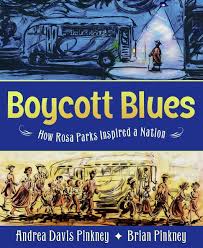
Boycott Blues is a story of Rosa Parks told in a bluesy, jazzy narration. In the background of the illustrations the reader can find a hound dog strumming his old guitar and imagine the sound of him telling this story in a sing-songing voice. The story is inspirational and relays the struggles of Rosa Parks and Dr. Martin Luther King Jr. as they lead African Americans in a fight for equal laws and treatment against the Jim Crow laws. Imagine yourself reading this story out loud and you might best picture yourself standing on stage with a guitar and jazz band behind you as you read the rythmic lyrics. Some of you readers out there, if you're brave like Rosa Parks, might make a podcast for the rest of us to enjoy!
Showing posts with label Multicultural. Show all posts
Showing posts with label Multicultural. Show all posts
Wednesday, September 26, 2012
Boycott Blues: How Rosa Parks Inspired a Nation
Pinkney, A.D., Pinkney, B. (2008). Boycott Blues: How Rosa Parks Inspired a Nation. Greenwillow Books.

Wednesday, September 5, 2012
The Firefly Letters
Engle, M. (2010). The Firefly Letters. New York: Henry Holt and Company.
This book peeks in the lives of four young people in mid-nineteenth century Cuba. The bulk of the story revolves around Cecilia, a young slave who was sold by her father for a stolen cow. Fredrika is a young Swedish suffragette who travels to Cuba to exercise her freedom as a woman and demonstrates how much a woman can do when she steps outside the expected societal path. Fredrika and Cecilia, while living difficult lives, appeal to Elena who is young, pampered and wealthy. But when Cecilia is pregnant and due to have a baby born into slavery, what can be done about it? (Grades 5 and up).

Inside Out and Back Again
Lai, Thanhha. (2011). Inside Out and Back Again. New York: Harper Collins Children’s Books.
A National Book Award Winner, this books introduces a topic rare to American literature. Set in the aftermath of the Vietnam war in Vietnam, a young girl adjusts to life without a father and in increasing poverty. The story travels to Atlanta where the family attempts to settle into a new way of life. She and her brothers find their way, keeping their interests ranging from kung-fu to medical sciences intact along the way. Written in poetic prose, the author tells a story of struggle and conquest through illuminating language. (Grade 3 and up).

Saltypie: A Choctaw Journey From Darkness Into Light
Tingle, T. (2010). Saltypie: A Choctaw Journey From Darkness Into Light. El, Paso, Texas: Cinco Puntos Press.
This non-fiction book written by a Choctaw member about his grandmother portrays a modern Native American family. The title “Saltypie,” compromises the pain and turmoil usually accompanied by discrimination when the boys grandmother teaches him how to use it to ease difficult situations. The boy is also surprised to learn of his grandmother’s blindness and learns of a subtle method she uses to cope with the disability. The book is honest and pleasant to read. (Grade 2 and up).

January's Sparrow
Polacco, P. (2009). January’s Sparrow. New York: Penguin Group.
This is heart-wringing story of a young girl’s family as they travel the Underground Railroad. It begins with a slave named January who carves a sparrow for the young girl, named Sadie. Readers may be appalled to read and see what happens to January through the text and illustrations. When Sadie’s family begins their journey the wooden sparrow is left behind. This story is written in the dialect of the slave families and the content of the story is emotional and best shared with older elementary or middle school students. (Grade 5 and up).

Black Elk's Vision
Nelson, S.D. (2010). Black Elk’s Vision: A Lakota Story. New York: Abrams.
Black Elk has a vision at an early age that he is unable to understand, process, or share with his tribe. He keeps it to himself until it becomes clear that the people need to hear his vision as it contains words of inspiration and wisdom which could be light in a moment of dark peril. The book contains several photographs which document the era and bring the book to live while grounding it in history. Black Elk becomes a member of Buffalo Bill’s Wild West show and travels to New York City and abroad until he returns home a few years later. As he ages and matures his message finally resonates with him and becomes the motto for how he lives his life. Highly informative and told from the perspective of a Native American at a time when Native Americans were gathered onto reservations against their will, this book is sure to captivate readers of all ages. (Grades 3 and up).

The Absolutely True Diary of a Part-Time Indian
Alexie, S. (2007). The Absolutely True Diary of a Part-Time Indian. New York: Hachette Book Group.

Arnold Spirit, or preferably Junior, is a courageous young teenager who takes the advice of a teacher to leave the reservation for his education. This decision results in a lot of beef for a kid who is used to fist fights, including the abandonment of his best friend, Rowdy. Junior plows his way into the school for white kids, 22 miles off the reservation, a distance he occasionally has to walk due to circumstances revolving around extreme poverty. A cartoonist, Junior, understands everything about the world in pictures and does an incredible job narrating the story of his year of transition from the school on the reservation to the white kids' school. After his move, he realizes he belongs neither here nor there and as certain events begin to spiral out of control, Junior makes sweeping discoveries about his heritage and his chosen path in life. An excellent read and highly recommended for readers 5th grade and up.
Ghandi: A Manga Biography
Ebine, Kazuki. (2010). Gandhi: A Manga Biography. New York, NY: Penguin Books.
This is a graphic novel of Gandhi's influential life. Beginning with Gandhi as a young boy this book portrays all of Gandhi's emotional evolution as he learns to be selfless and speak in front of huge crowds using Indian teachings that are thousands of years old. His non-violent methods created waves of movement first in South Africa and then in India. By telling Gandhi's story through a graphic novel this valuable lesson in history becomes available to many more readers. Unfortunately, several spelling errors, one even in Gandhi's name may deter readers, but the series by Penguin is one to watch in order to provide this information to reluctant readers. (Grades 5 and up).

Ninth Ward
Parker Rhodes, J. (2010). Ninth Ward. New York: Little, Brown And Company.
This wonderful story tells of a young girl’s experience during hurricane Katrina. Only, she is not just any young girl - she has “the sight” which enables her to see ghosts, including her own mother who lays on the bed upstairs. The story tells of a young girl’s loss, triumph, and growth in the midst of a horrible natural disaster and provides the perspective that may be misunderstood by others of those who could not evacuate. Ninth Ward is written in the dialect of those from the ninth ward in New Orleans and demonstrates how far a mother and guardian will go for the child they love. (Grade 4 and up).

90 Miles to Havana
Flores-Galbis, Enrique. (2010). 90 Miles to Havana. New York, New York: Roaring Brook Press.
Julian is a young boy swept up in a Cuban Revolution and sent by his parents to Miami, Florida, where the government officials cannot touch him. Here he is placed in a camp ruled over by a child-dictator, which calls for a mini-revolution carried out by the children. In this way Julian learns about revolution and dictatorship first-hand and understands the implications of a democratic society. Julian runs away from the camp and also learns what it means to live an unsheltered life while retaining his superior moral character. Julian meets Tomas who is fixing up a boat to help reunite more families in Miami. Can Julian help Tomas and will he find his family again? After this experience, will Julian ever be able to be a boy again and will his family accept him for who he really is? This is an excellent book and provides invaluable insight to a little known historical event. (Grades 5 and up).

A Time of Miracles
Bondoux, Anne-Laure. (2009). A Time of Miracles. New York: NY, Delacorte Press.
A mother goes to extremes to keep her child safe. Gloria is raising Blaise and tells him the story of how she rescued him from a derailed train. In the story his mother is carted away but we never know what becomes of her and Blaise is raised by Gloria in the midst of the collapse of the Soviet Union. Throughout the collapse is severe political unrest and Gloria and Blaise flee the civic chaos. Gloria heads toward France but when the path becomes too dangerous she finds passage for Blaise and is left behind. As Blaise grows up he struggles to understand his identity and searches relentlessly for his mother, but when that search proves fruitless he realizes he must find Gloria. This story is heartbreaking and extremely insightful. (5th grade and up).

Subscribe to:
Posts (Atom)